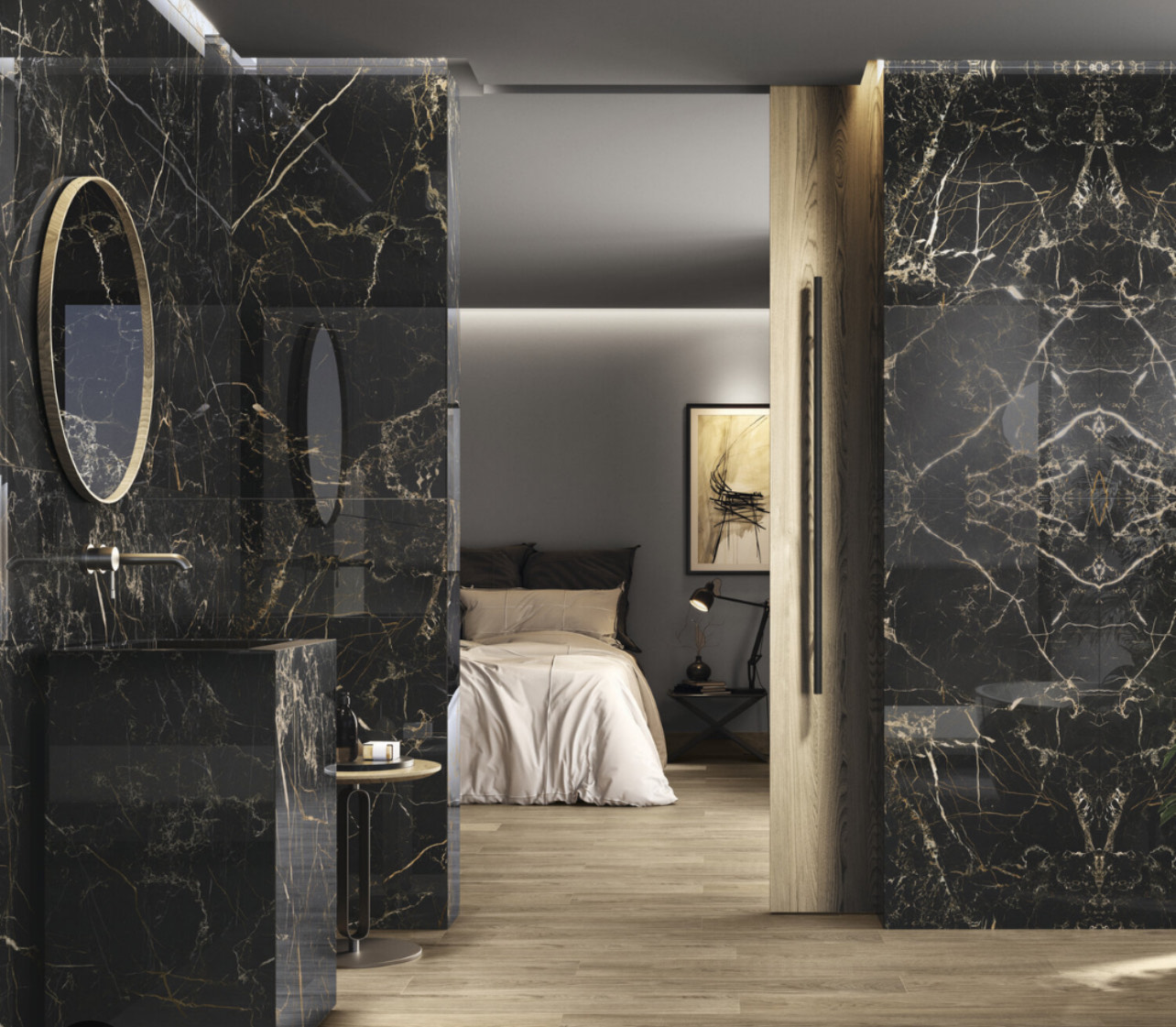
Large format tile transforms a bathroom. The minimal grout lines, the clean continuous surface, the way it makes a space feel larger — it's one of the most dramatic upgrades available without moving walls. It's also one of the most technically demanding tile installations you can attempt.
We specialize in large format tile installation across Ottawa, Orléans, Rockland, Kanata, Barrhaven, and surrounding communities. We understand what it takes to set 24×48 and 32×32 rectified porcelain without lippage, hollow spots, or cracked tiles — and we do it consistently.
Why Large Format Tile Installation Is Different
Subfloor Flatness
Large format tile requires a flat substrate — typically within ⅛″ over 10 feet. Any deviation reads as lippage across the face of a large panel. Before we set a single tile, we assess the floor, grind down high spots, and fill low areas with appropriate leveling compound. This prep work takes time. It's also what separates a finished floor that looks right from one that looks like it was installed in a hurry.
Back-Buttering
Large tiles need thinset on the tile back AND the substrate. We use a large-notch trowel and back-butter every piece to achieve the contact coverage required — 95% in wet areas, with no voids. A hollow tile on a large format floor isn't just aesthetically wrong; it's structurally at risk of cracking under point load.
Leveling Clip Systems
We use tile leveling clips on every large format tile installation in Ottawa and Orléans. Clips are inserted under tile edges during installation and wedges are driven in to hold adjacent tiles flush. Once the thinset sets, the clips snap off cleanly. The result is a field with consistent height across every joint — no lippage visible in raking light, no edges catching underfoot.
Thinset Selection
Large and heavy tile requires a large-format-rated thinset with appropriate open time and non-sag properties for vertical applications. Using the wrong thinset on large format wall tile causes slippage during installation and reduced coverage once cured. We spec the right product for the tile weight, substrate, and orientation.
Movement Joints
Large format tile needs movement joints at perimeter walls and field breaks to accommodate thermal expansion — particularly important in Ottawa's climate with its significant temperature swings. These joints are filled with appropriate sealant — not grout — because grout has no flexibility. Movement joints are not optional; they're part of a correct installation.
Large Format Tile on Floors vs. Walls
Floor installations are primarily a flatness and coverage challenge. Wall installations add the challenge of gravity — large tiles need non-sag thinset, back-buttering, and sometimes temporary supports while the thinset develops early strength. We handle both routinely and adjust our approach to suit the orientation.
Formats We Install in Ottawa and Orléans
- 24×24 porcelain and natural stone
- 24×48 book-matched and vein-cut porcelain
- 32×32 rectified porcelain — straight set and offset
- 12×24 straight-set and staggered
- Oversized porcelain slabs with appropriate substrate preparation
- Large format marble-look and concrete-look porcelain
The Bridge Saw: Why It Matters for High-End Tile Work
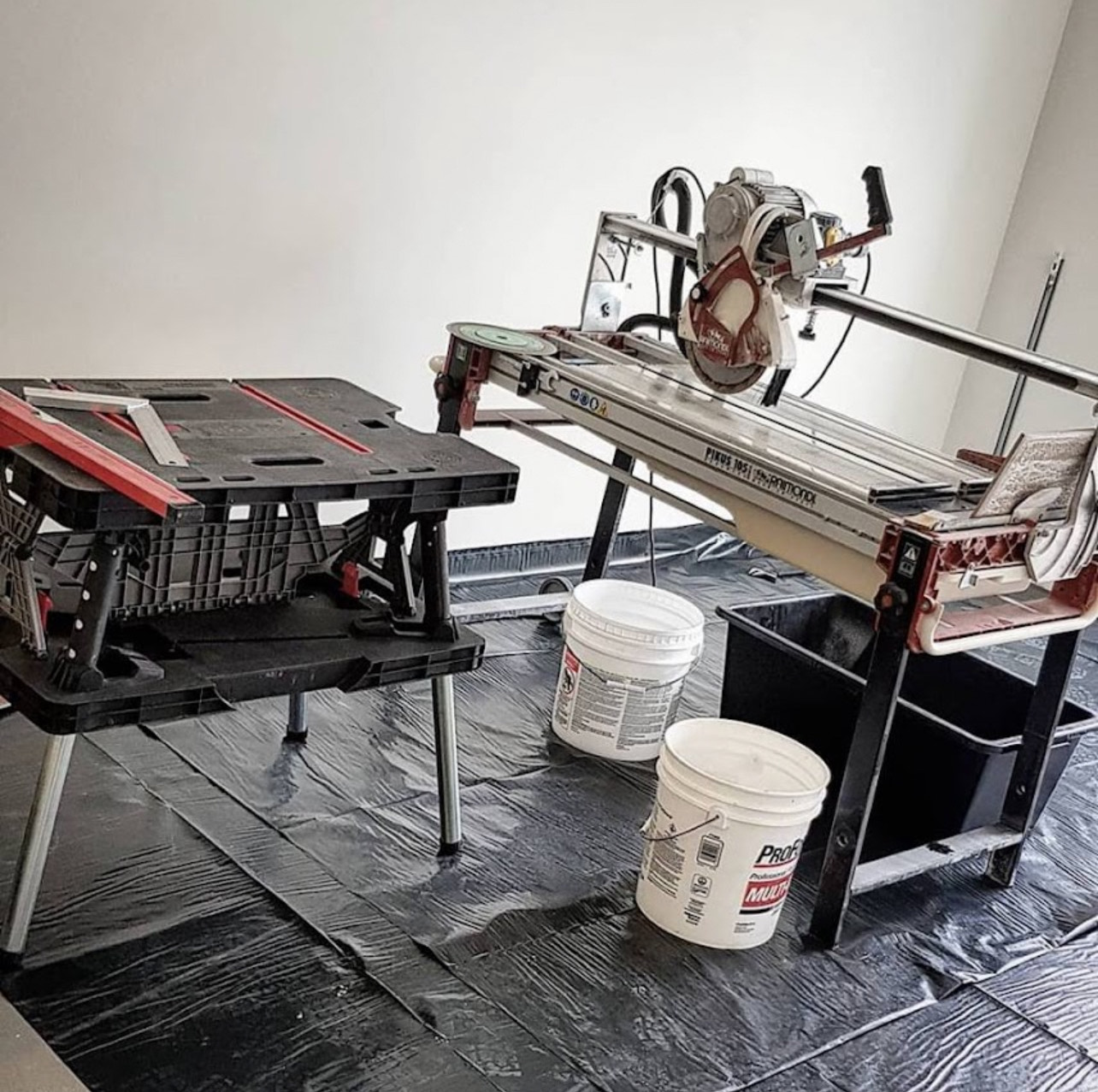
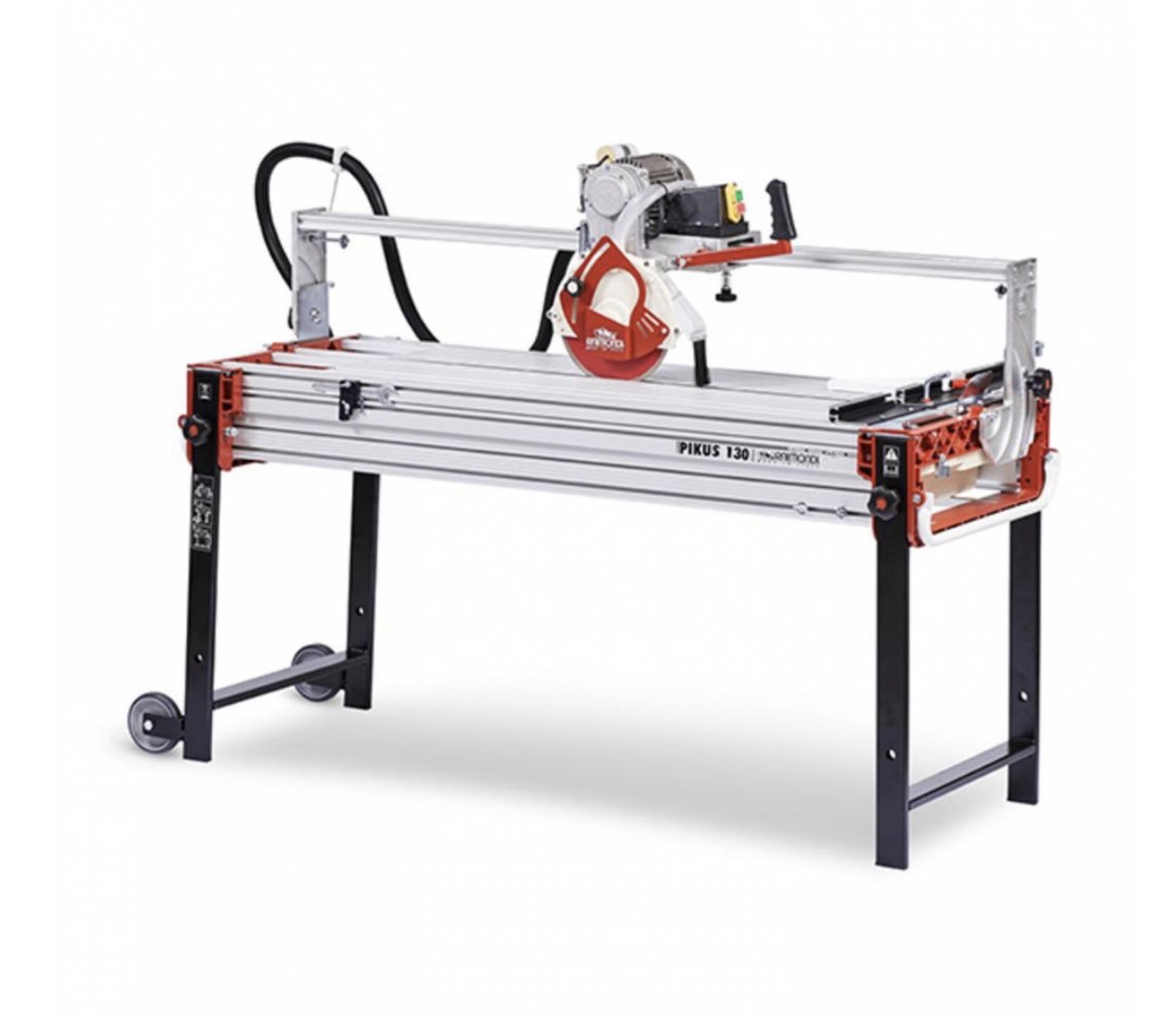
A bridge saw is a fixed-rail wet saw where the cutting head travels on a precision overhead gantry — unlike a standard wet saw where the tile slides into the blade. For large format tile, niche cuts, mitred corners, and complex cuts, this distinction is critical.
Niche Cuts
A built-in shower niche requires four precise L-shaped or straight cuts that must be perfectly square and chip-free. On rectified large format tile, a single chipped edge ruins the piece — and chips are exactly what happen when a heavy slab deflects on a standard roller table. The PIKUS 130 holds the tile rigid on a full-length support bed, so the blade is always in the same relationship to the tile regardless of slab weight or size. No deflection. No vibration. Clean cut edges.
Corner Cuts and Internal Corners
Inside corners on a tiled wall or shower require cuts accurate to within 1–2mm. On a standard wet saw, a 24×48 tile hanging over the edge of the table introduces wobble that compounds as the cut progresses. On a bridge saw, the cut head travels on rails — the geometry is fixed. Internal corners land exactly where they need to, and the tile doesn't crack during the cut.
Mitered 45° Cuts
A mitered tile corner — where two tiles meet at 45° angles to form a seamless edge — is one of the most technically demanding cuts in tile work. It requires an angled blade, a perfectly consistent cut depth, and a tile that doesn't shift mid-cut. Done correctly on a bridge saw with the PIKUS 130's adjustable tilt head, the result is a hairline-tight corner with no exposed raw edge. Done on a standard saw, the result is almost always a gap, a chip, or an angled mismatch. Mitered corners on large format black marble-look tile — the kind visible in the photo above — are only achievable with a bridge saw.
Dust Extraction: Health, Cleanliness, and Professionalism
Cutting porcelain, natural stone, and concrete board generates respirable silica dust — a known carcinogen classified as a Group 1 substance by the International Agency for Research on Cancer. A single day of dry cutting without extraction exposes the work area, adjacent rooms, and the installer to dust concentrations that far exceed safe exposure limits.
The Hilti VC 150-10 X HEPA Extractor
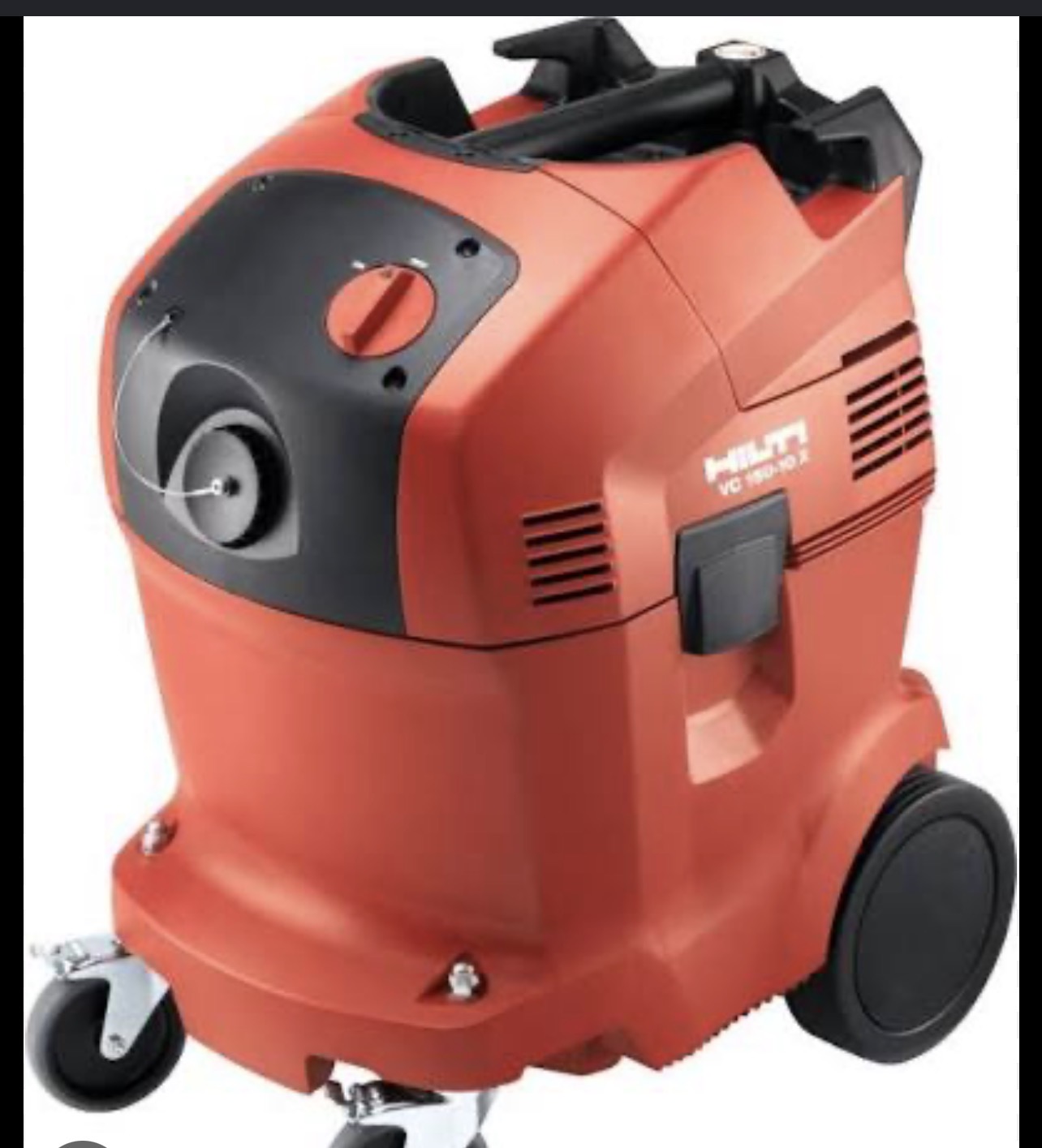
We use the Hilti VC 150-10 X — a Class H HEPA dust extractor — connected to our cutting and grinding tools throughout every project. Class H filtration captures 99.995% of particles at 0.3 microns, including silica dust. The extractor runs continuously during all dry cutting, grinding, and demolition work.
Why It Matters in a Residential Home
Silica dust settles invisibly on every surface in a home and re-enters the air each time the room is disturbed. In a bathroom renovation, cutting without extraction means months of silica contamination throughout the home — in HVAC systems, on furniture, and on surfaces the homeowner touches daily. We use HEPA extraction on every project, not because it's required, but because it's the correct way to do the work in someone's home.
Clean Job Sites
Proper dust extraction also means a clean job site at the end of every day. We protect adjacent flooring and surfaces with plastic sheeting, run the extractor during all cutting, and leave the space as clean as we found it. A renovation is already disruptive — this is one area where the right equipment makes a meaningful difference to the homeowner.
Frequently Asked Questions
What is rectified tile?
Rectified tile is precision-cut after firing so every piece has exactly the same dimensions. This allows for very narrow grout joints — typically 1.5–2mm — creating the clean, minimal look that makes large format tile so visually impactful. Most large format porcelain is rectified.
What is lippage and why does it matter?
Lippage is the height difference between the edges of two adjacent tiles. On large format tile, even 1mm of lippage is visible in any directional light and creates an uneven surface underfoot. Eliminating it requires flat substrate prep and leveling systems — both of which we use on every large format project.
Can large format tile be used in a shower in Ottawa?
Yes — and it looks exceptional. The preparation requirements are the same as for floor installations, with the addition of proper waterproofing behind the tile assembly. We install large format tile in showers regularly across Ottawa and Orléans.
Do you need leveling clips for large format tile?
Yes. Leveling clip systems are essential for large format tile installation. Without them, achieving consistent height across every joint is extremely difficult — and the result will show in raking light.